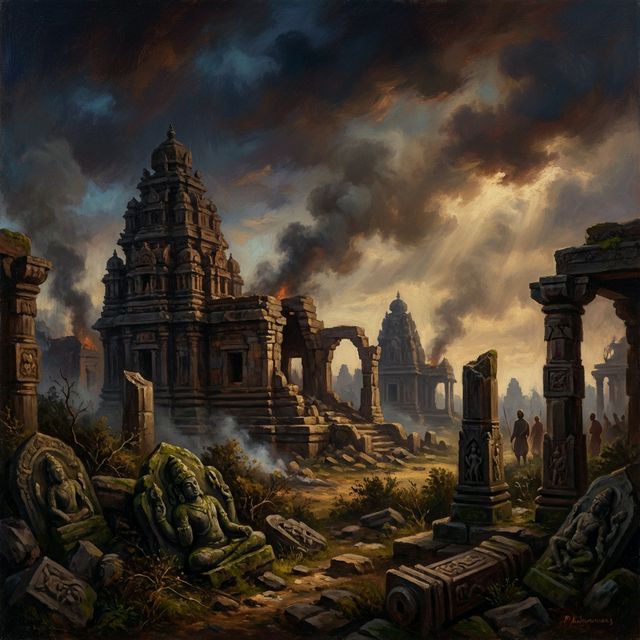
Dramatic painting of ancient Indian Hindu temples in ruins during the Mughal era — crumbling carved stone pillars and ornate walls, smoke rising, deep indigo and amber atmospheric sky, representing the devastation of sacred heritage during Aurangzeb's 49-year reign

Aurangzeb Alamgir The Untold History They Don't Want You to Know

What your textbooks never taught you. A comprehensive, source-backed chronicle of the destruction, persecution, and cultural devastation inflicted during the 49-year reign of Mughal Emperor Aurangzeb Alamgir (1658–1707 CE) — and how India still bears its scars today.

Scroll to explore
📊 The Scale of Destruction

The Numbers They Don't Teach

Documented by Mughal court chroniclers, archaeological surveys, and primary historical records — the scale of Aurangzeb's campaign against Hindu and Sikh civilization.

🏛️
0
Temples Destroyed or Desecrated
Per Maasir-i-Alamgiri, ASI Reports & Scholarly Estimates
📅
0
Years of Tyrannical Rule
Reign: 1658–1707 CE
⚖️
0
Jizya Tax Reimposed on Hindus
Reimposed in 1679 CE after 100+ years
⚔️
0
Estimated Lives Lost in Wars
Deccan Wars, Sikh & Maratha campaigns
🧭 Your Journey Through History

What This Encyclopedia Covers

Navigate through each chapter to uncover the layers of truth that have been systematically hidden, whitewashed, or overlooked in mainstream education.

📖
The sanitized textbook narrative vs. documented reality
Chapter 1

The Official Narrative

How Indian textbooks portray Aurangzeb as a "pious, austere ruler" while systematically omitting his documented atrocities against Hindus, Sikhs, and his own family.

Uncover the truth
📅
49 years of documented destruction, year by year
Chapter 2

Timeline of Atrocities

An interactive, chronological walk through every major documented event — from seizing the throne in 1658 to his death in 1707 CE.

Walk through time
🏛️
Sacred temples razed — Kashi Vishwanath, Mathura, and thousands more
Chapter 3

Temple Destructions

The 1669 farman ordering demolition of all Hindu temples. Kashi Vishwanath became Gyanvapi Mosque. Krishna Janmabhoomi was desecrated. Thousands of temples fell.

See the evidence
⛓️
Jizya, forced conversions, and systematic religious oppression
Chapter 4

Religious Persecution

Reimposition of Jizya. Discriminatory laws. Forced conversions. The execution of Guru Tegh Bahadur. The torture and murder of Sambhaji. Mass persecution campaigns.

Read the accounts
⚔️
Wars against Marathas, Sikhs, Rajputs, and his own brothers
Chapter 5

Military Campaigns

The 27-year Deccan War. The betrayal and murder of Dara Shikoh. Wars against Shivaji and the Marathas. Sikh persecution campaigns. The human cost.

Study the campaigns
🎭
Music banned, art suppressed, centuries of culture — erased
Chapter 6

Cultural Destruction

Beyond temples — Aurangzeb banned music, dismissed court musicians, suppressed art, destroyed libraries, and attacked the very foundations of Indian culture.

Understand the loss
📊
Data visualization of the scale of destruction
Chapter 7

The Damage Quantified

Numbers, statistics, and data — temples lost, taxes imposed, lives destroyed, economic devastation, and the measurable impact that persists today.

See the numbers
🔗
How the past connects to India's present struggles
Chapter 8

Legacy & Modern Impact

The Gyanvapi case. The Mathura dispute. Streets named after him. The whitewashing in academia. How Aurangzeb's destruction echoes in India's present.

Connect past to present
📚
Complete bibliography of primary and secondary sources
Chapter 9

Sources & References

Every claim is backed by primary sources — Maasir-i-Alamgiri, Muntakhab-ul-Lubab, Jadunath Sarkar, ASI reports, and modern scholarship. Verify everything.

Verify the sources
The temples of the infidels have been demolished. His Majesty ordered the grand temple at Banaras to be destroyed, and the Vishweshwar temple was demolished. In its place a grand mosque was erected. The idols were given to be trodden under foot. — Maasir-i-Alamgiri (Official Court Chronicle of Aurangzeb), by Saqi Must'ad Khan, c. 1710 CE
Wikipedia: Maasir-i-Alamgiri
⚠️ Why This Matters Today

The Kashi Vishwanath Temple at Varanasi — demolished by Aurangzeb in 1669 CE and replaced with the Gyanvapi Mosque — remains one of India's most contested sites to this day. The Archaeological Survey of India (ASI) survey in 2023 found evidence of Hindu temple structures beneath the mosque. The Mathura Krishna Janmabhoomi case is similarly active in the courts. Understanding this history is not about revenge — it is essential for informed civic participation and the pursuit of historical justice through democratic and legal means.

🔍 Textbook vs. Reality

The Two Faces of Aurangzeb

One version lives in textbooks. The other is documented in primary sources written by Aurangzeb's own court historians.

📗
What Textbooks Say
  • "A pious and austere ruler"
  • "Personally lived a simple life"
  • "Administered a vast empire efficiently"
  • "His religious policies were misunderstood"
  • "Gave grants to Hindu temples too"
  • "The Mughal Empire reached its maximum extent"
📕
What History Documents
  • Issued the 1669 farman ordering demolition of Hindu temples
  • Destroyed Kashi Vishwanath and built Gyanvapi Mosque over it
  • Razed Krishna Janmabhoomi at Mathura
  • Reimposed Jizya tax on all non-Muslims in 1679
  • Ordered execution of Guru Tegh Bahadur for refusing conversion
  • Had Sambhaji tortured and brutally executed
  • Murdered his own brothers Dara Shikoh, Murad, Shuja
  • Banned music and dance from the Mughal court
🕯️ Education is the First Step

History Forgotten is History Repeated

This website exists because every Indian has the right to know their true history. Every claim is backed by primary historical sources. Every fact is verifiable. Begin your journey through the chapters that textbooks left out.