Chapter 1
The Official Narrative
How textbooks have portrayed Aurangzeb Alamgir — and what they systematically omit.
How textbooks have portrayed Aurangzeb Alamgir — and what they systematically omit.
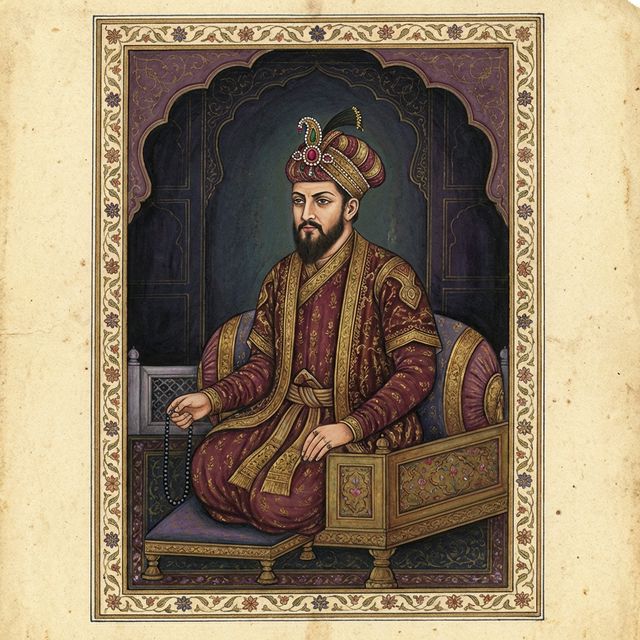
Open any standard Indian history textbook — NCERT or state board — and you'll find Aurangzeb described in remarkably sanitized terms. The typical portrayal includes:
This portrayal is not accidental. It is the result of decades of deliberate historiographic choices made by textbook committees influenced by political ideologies that prioritized "communal harmony" over historical accuracy. The result: generations of Indians who don't know their own history.
The following facts are not allegations — they are documented in Aurangzeb's own court chronicles, written by Muslim historians who served him. These sources recorded his actions as achievements, not accusations:
Aurangzeb issued a direct imperial farman (order) commanding the demolition of Hindu temples and schools across his empire. This is not a disputed claim — it is recorded in his own official chronicle, the Maasir-i-Alamgiri by Saqi Must'ad Khan:
Aurangzeb fought a brutal war of succession against his own brothers. He had Dara Shikoh — the rightful heir, known for his religious tolerance and translation of the Upanishads — paraded through the streets of Delhi in humiliation and then executed in 1659. He imprisoned his father Shah Jahan in Agra Fort for 8 years until his death.
In 1669, Aurangzeb ordered the demolition of the ancient Kashi Vishwanath Temple at Varanasi, one of the holiest Hindu shrines. The Gyanvapi Mosque was built over its ruins. The original temple's western wall still stands as part of the mosque structure — a permanent reminder of the desecration. The 2023 ASI survey confirmed Hindu temple remnants beneath the mosque.
When Kashmiri Pandits approached Guru Tegh Bahadur, the ninth Sikh Guru, for protection against forced conversions, the Guru went to Delhi to confront Aurangzeb. He was arrested and given the choice: convert to Islam or die. He chose martyrdom. He was beheaded at Chandni Chowk, Delhi, on 11 November 1675. This led his son, Guru Gobind Singh, to found the Khalsa in 1699.
After it had been abolished by Akbar over a century earlier, Aurangzeb reimposed the Jizya tax on all non-Muslims in 1679. Massive protests erupted — Mughal records describe crowds gathering at the Red Fort, with Aurangzeb's elephants trampling the Hindu protesters. The Jizya was a tool of economic oppression and religious humiliation.
The sanitization of Aurangzeb's history was not accidental. It was the result of specific historiographic and political choices:
After 1947, Indian textbook committees chose to downplay the religious dimensions of medieval history to promote "communal harmony." The intent may have been noble, but the result was a generation of Indians who were lied to about their own heritage.
The dominant school of Indian historiography from the 1960s–2000s was heavily influenced by Marxist historians like Romila Thapar, Irfan Habib, and others who interpreted medieval history primarily through economic and class lenses, minimizing the religious motivations explicitly stated in the primary sources themselves.
Successive governments avoided correcting the historical record because acknowledging the religious nature of Mughal atrocities was considered politically risky. Historical truth became a casualty of electoral calculations.
Western academia, influenced by Edward Said's "Orientalism" framework, often dismissed documentation of Islamic conquests as "Hindu nationalist propaganda" — despite the evidence coming from Muslim court chroniclers themselves. Audrey Truschke's 2017 book "Aurangzeb: The Life and Legacy of India's Most Controversial King" is a prime example of this sanitization trend.