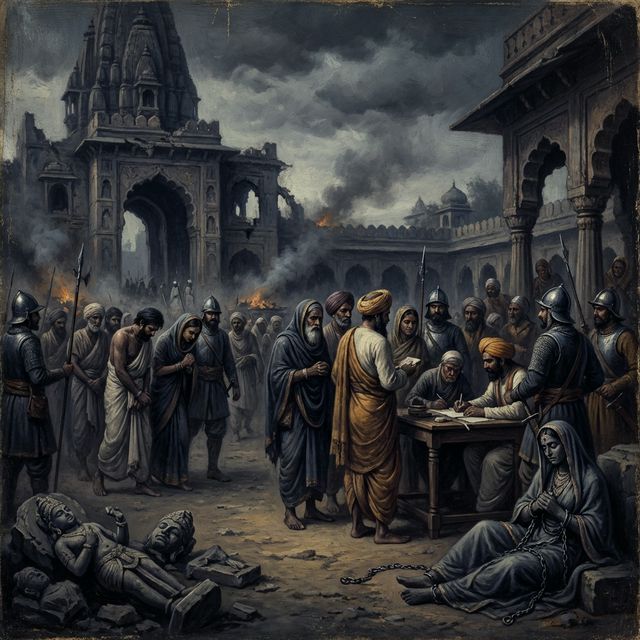
The Jizya Tax (1679 CE)

After Akbar had abolished it 115 years earlier, Aurangzeb reimposed the Jizya — a discriminatory poll tax levied exclusively on non-Muslims. This was both economic exploitation and religious humiliation:

  • Non-Muslims had to pay the tax annually as a condition for being allowed to live and practice their faith
  • Collection was accompanied by public humiliation rituals described in sharia manuals
  • Hindu merchants and artisans were economically crippled
  • Many were forced to convert simply to escape the financial burden
When Rajput and Hindu nobles protested the Jizya at the Red Fort, Aurangzeb ordered elephants to be driven into the crowd. Many were trampled to death. — Maasir-i-Alamgiri; Akhbarat records, 1679 CE

Discriminatory Laws

Beyond Jizya, Aurangzeb implemented a comprehensive system of discriminatory regulations against non-Muslims:

  • Ban on Hindu festivals: Public celebration of Holi, Diwali, and other Hindu festivals was prohibited
  • Dress code: Hindus were forbidden from wearing fine clothes, riding horses, or carrying arms
  • Employment ban: Hindus were systematically removed from government positions and replaced with Muslims
  • Construction ban: Building new temples or repairing existing ones was forbidden
  • Music ban: Music and dance were banned from public and court life
  • Trade restrictions: Higher customs duties (5%) imposed on Hindu merchants vs 2.5% for Muslims
  • Education suppression: Hindu schools and centers of Sanskrit learning were ordered closed
📜 Source

These regulations are documented in the Fatawa-i-Alamgiri, the comprehensive compilation of Islamic law commissioned by Aurangzeb himself, and in the Akhbarat (court newsletters).

Forced Conversions

Mass forced conversions were a systematic policy, not isolated incidents:

Kashmir

The Kashmiri Pandits faced intense persecution and forced conversion campaigns. It was their desperate appeal that led Guru Tegh Bahadur to confront Aurangzeb, resulting in his martyrdom in 1675.

Gujarat

In Gujarat, the governor Firoz Khan carried out conversions of entire communities, particularly targeting the Rajput and Brahmin populations.

Bengal

In Bengal, forced conversions were particularly aggressive under governors who competed to show their zeal. Entire villages were forcibly converted, with refusal punished by death or slavery.

The Deccan

During the 27-year Deccan campaign, forced conversions accompanied military conquests. Captured soldiers and civilians were given the choice of conversion or death.

Martyrdom of Guru Tegh Bahadur (1675)

This is perhaps the most significant act of religious persecution in Indian history — a spiritual leader executed for defending the religious freedom of another community:

  • Kashmiri Pandits approach the Guru, begging for protection against forced conversions
  • Guru Tegh Bahadur goes to Delhi to confront Aurangzeb
  • He is arrested and imprisoned at the Red Fort
  • His three companions — Bhai Mati Das, Bhai Sati Das, and Bhai Dayala — are tortured and killed before his eyes
  • Bhai Mati Das is sawn in half alive
  • Bhai Dayala is boiled in water
  • The Guru is given the choice: convert or die. He refuses
  • He is publicly beheaded at Chandni Chowk, Delhi, on November 11, 1675
"He gave his head but not his faith." — Guru Gobind Singh, describing his father's martyrdom

The site of his execution is today marked by Gurdwara Sis Ganj Sahib at Chandni Chowk, Delhi. Further reading on this topic is available at Bharat Files.

Torture of Chhatrapati Sambhaji (1689)

The execution of Sambhaji Maharaj remains one of the most horrific acts of cruelty documented in Indian history:

  • Captured through treachery in February 1689
  • Brought before Aurangzeb in chains
  • Offered his life and territory if he converts to Islam
  • He refuses with contempt
  • Tortured for weeks: eyes gouged out, tongue cut off, nails pulled out
  • Finally executed by tearing his body apart on March 11, 1689
  • His companion, the poet Kavi Kalash, was similarly tortured and killed for refusing conversion

Far from breaking Maratha resistance, Sambhaji's martyrdom galvanized the Marathas into an even fiercer resistance that eventually destroyed the Mughal Empire.

Persecution of the Sikh Community

The Sikh community endured sustained persecution throughout Aurangzeb's reign:

  • 1675: Execution of Guru Tegh Bahadur
  • 1699: Guru Gobind Singh creates the Khalsa specifically to resist persecution
  • 1704: Siege of Anandpur Sahib — Guru Gobind Singh forced to evacuate
  • 1704: Battle of Chamkaur — two elder sons of Guru Gobind Singh die fighting
  • 1704: The two younger sons (Sahibzada Zorawar Singh, age 9, and Sahibzada Fateh Singh, age 6) are bricked alive at Sirhind for refusing to convert to Islam
  • 1704: Mata Gujri, the mother of Guru Gobind Singh, dies in captivity
⚠️ The Most Horrific Act

The bricking alive of the Sahibzadas — children aged 6 and 9 — for refusing to convert remains one of the most horrific acts of religious persecution in recorded history. The site at Fatehgarh Sahib, Punjab, is commemorated annually on Shaheedi Jor Mel.

Next Chapter
Military Campaigns →
Continue the Journey