Chapter 3
Temple Destructions
The 1669 farman and its devastating consequences — documented from Aurangzeb's own court chronicles.
The 1669 farman and its devastating consequences — documented from Aurangzeb's own court chronicles.
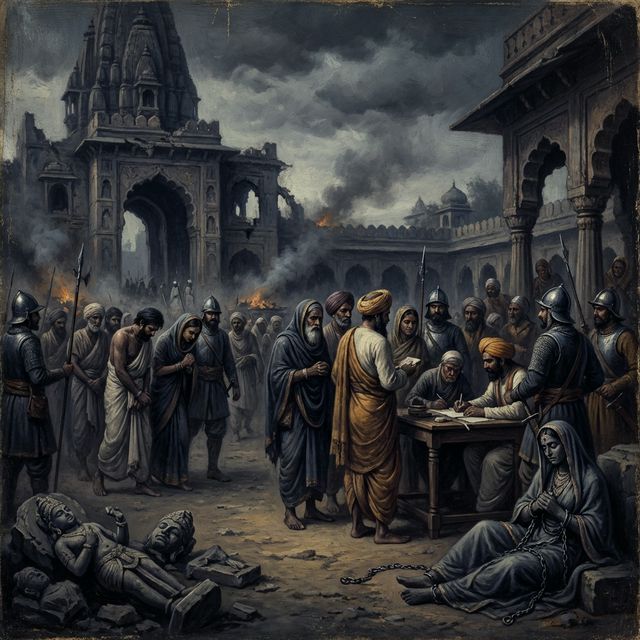
On 9 April 1669, Aurangzeb issued the most devastating imperial farman in Indian history. Recorded in his own official court chronicle:
This was not a one-time event but a standing imperial policy. Governors and local officials across the empire competed to implement this order, leading to the destruction of thousands of temples over the next four decades.
Each entry below is sourced from primary Mughal chronicles and/or ASI reports.
One of the holiest Hindu shrines, demolished in 1669 under direct orders. The Gyanvapi Mosque was built over its ruins. The original temple's western wall is still embedded in the mosque. ASI survey (2023) confirmed Hindu temple remnants underneath. Active legal case ongoing.
Maasir-i-Alamgiri • ASI Report 2023The grand temple at the birthplace of Lord Krishna, rebuilt by Raja Bir Singh Deo Bundela, was demolished. The Shahi Idgah was built on part of the site. Court chronicle records: "In a short time, by the great exertions of his officers, the destruction of this strong foundation of infidelity was accomplished." Active legal case ongoing.
Maasir-i-Alamgiri • Muntakhab-ul-LubabThe temple at Somnath, which had been repeatedly destroyed and rebuilt, was attacked again under Aurangzeb's orders. This was the latest in a series of destructions dating back to Mahmud of Ghazni (1026 CE). The current temple was rebuilt after India's independence under Sardar Patel's initiative.
Mirat-i-Ahmadi • Futuhat-i-AlamgiriThis ancient Vishnu temple at the Panchganga Ghat in Varanasi was destroyed in the same campaign as Kashi Vishwanath. The Dharahara Mosque was built at the site.
Maasir-i-AlamgiriNumerous temples across Rajputana were destroyed during Aurangzeb's campaigns against the Rajput kingdoms. The Rajputs, former Mughal allies, were pushed into open rebellion by these policies. Temples at Jodhpur, Udaipur, Chittor, and Amber were targeted.
Maasir-i-Alamgiri • Rajasthani chroniclesDuring the 27-year Deccan campaign, Aurangzeb's forces destroyed hundreds of temples across southern India. Temples in Golconda, Bijapur, and across the Maratha territories were demolished as part of military campaigns and religious policy.
Maasir-i-Alamgiri • Futuhat-i-AlamgiriHistorian Sita Ram Goel, in his two-volume work Hindu Temples: What Happened to Them, documented over 2,000 specific temple destruction instances across medieval Islamic rule in India, with Aurangzeb's reign accounting for a significant proportion. Jadunath Sarkar's History of Aurangzib provides detailed accounts. ASI records list thousands of mosque and dargah structures built on or from temple materials.
The Gyanvapi case (Varanasi) and the Krishna Janmabhoomi case (Mathura) are both active in Indian courts. The Places of Worship Act, 1991, which froze the religious character of all sites as of August 15, 1947, is itself being legally challenged. These are not ancient history — they are live constitutional questions that every Indian citizen should understand. For further reading on this topic, visit Bharat Files.